This blog is best viewed with the latest browser and an open mind!

Friday, April 21, 2023

India 5: An Uncanny Tale - The Epilogue

Well, not quite. Just sharing a few things.


The response to my Gupta Cha posts (Part 1 and Part 2) was overwhelming and completely bowled me over. And having them featured on ATP was fantastic, given the number of visitors who visit that remarkable site.

Then, just as Indian and Pakistani comments and emails about it began to understandably dwindle with time, the dreadful Mumbai Massacre struck. I blogged on the morning of December 2nd about it. The post got a few visits and drew one comment by the end of the day. After all, it wasn't a unique post. Millions were - once they got their eyeballs off their TV screens - reading the news, live accounts, conflicting reports, seasoned analysts, and far better blogs than mine. The sole comment had come from a Sarah Islam, who, I think was a first-time visitor to my blog. This led to an exchange in the comments section that ended on a warm note. The next morning, I received an email from her ... and the few exchanges that followed are being reproduced here - with her permission (she probably succumbed to my 'threat') - as I think her story is worth sharing and contains much food for thought.
 
==================== Dear Mr. Kidvai I have just read your blog entry entitled 'An Uncanny Tale...' about Gupta cha. This is absolutely beautiful! Are you seriously working on your novel "Ships and Shoes and SealingWax"? Are you then looking for a publisher or have you already spoken to someone? I could help you look for one here in India. You keep saying that you are a non writer, but I assure you that your writing has really touched me. I am dying to read the rest of your story and I am sure that a couple of thousand other people would be too :) I was born in Libya in 1971 to a Punjabi mother from Lahore and a Bangladeshi father whose family had fled to Dhaka (Dacca as it was called then) from Calcutta (now Kolkata :) ). My family and I lived in Lahore in the 90's and moved back to Dacca in 1998 after the death of my father. I met my husband there and now I am happily married and live in Calcutta! So you can say that life has now come full circle for me! My husband Sukhendu and I struggled with all the prejudices that people in all the three countries live with and also certain opinions that we had been brought up with. Now I am proud to say that we have reached a peaceful stage where the blinkers have literally been taken off of our eyes :) Sukhendu and I read your story about Gupta Cha together and cried when we reached the end. Please let us know if we can help in any way for you to finish your book and publish it so other people can also read your story. Peace! Sarah ==================== Dear Sarah (and Sukhendu) I am very touched by your comments and also thank you for sharing your own past, briefly, with me. Ships and Shoes and SealingWax is not intended to be a novel - I would not even dare undertake such a venture. It is being written, mainly, in response to pressure from my daughter and my almost-adopted daughter, Sabeen (both of whom you will encounter if you go through my blog archives). The book will, in all probability, be almost blog-like: anecdotal and all over the place! Though I hope to bring some continuity into it. Do write back and tell me more about yourselves and your family. Where do you live? What do you do? Why not share stories on a blog about your own unique experiences and difficulties that you defeated to reach today's peaceful life? Peace! Zaheer ==================== Dear Mr. Kidvai I am so happy to hear back from you! We live in Lake Gardens which is beind Jodhpur Park in South Kolkata. I wonder if you know the place? My husband and I both worked in advertising, he is now creative director (art) at Ogilvy & Mather and I used to be a copywriter but am only writing freelance pieces for magazines now. We met in 1998 in Dhaka where we both worked for McCann Erickson. I had a huge chip on my shoulder as I had just returned from Pakistan and him being Indian was enough reason for me to contradict everything he said ... hahaha :-) My family had returned from Libya in 1989 and decided to settle down in Dhaka. But after a few years, my mother packed off my brother Amber to Aitchison College in Lahore and my sister Reema and I to Lahore. So that is how we landed up in Pakistan. My parents joined us for a while but for most of the time, my sister and I lived with my nani amma on Nisbet Road. After we got married in 2004, my mother was very unhappy with my decision as she had seen the carnage in Amritsar and, later on, on the train to Lahore. She was only 6 at the time but she can recall certain events very clearly. I can understand that, as the events must have been pretty horrible and must have been burnt on her brain. She met my father Dr. Nurul Islam in Benghazi (Libya) and their marriage in 1970, too, was quite controversial as there was talk of East Pakistan asking for independence from West Pakistan. Anyway, I was brought up in a house where both cultures, Punjabi and Bengali, were very much in evidence and I was very happy as a child and most of my time was spent chasing after butterflies, making mud pies and reading from the ancient books that my grandfather had left us and the newer books that we bought every now and then. My mother was adamant that we should learn Urdu as she is of the opinion that having Urdu as our first language would help us speak beautifully and articulately. She was and still is a stickler for the right pronunciation:-) So we went to the Pak Libya School that was run by the Pakistani Embassy in Benghazi. For nurturing our Bengali heritage we were dutifully packed off for singing, dancing and Bangla lessons at Hafiz uncle's house. So at school we spoke in Pidgin Italian, a bit of Arabic and Punjabi/Urdu, at home we spoke in Urdu and English and Bengali for some of our guests and in front of my father (especially when he was cross) :-) I was brought up in a liberal household but after my father's death in 1998, my mother suddenly discovered her Pakhtun roots (my grandfather had settled in Lahore but was originally from Swat) and started attending Quran classes and sympathizing with the radical Islamization of Bangladesh. This was a shock for me and I rebelled. Over the years my distance from my mother and her views became considerable. Now we are talking again and things are getting better :-) In the beginning, I would get very defensive with Sukhendu whenever something like the BJP used to come up in conversations but then I was reminded of a story that I think has largely shaped my thinking. At school I learnt from textbooks that one Rashid Minhas was the recipient of the Nishaan-e-Haider and a brave and valiant soldier who had grappled with the Bengali flight Instructor, Flight Lietenant Matiur Rahman who was a traitor. I grew up hero worshipping Minhas. When I came back to Bangladesh, I was shocked to learn that for the Bengalis it was Matiur Rahman who was the hero and not Rashid Minhas, who they considered the enemy. I realized then that the history of India, Pakistan and Bangladesh is so intertwined and so full of passion and extraordinary circumstances that it is impossible to take sides. Both men as I see it today were heroes and valiant soldiers who just happened to be on opposite sides of the cause. It was an accident of birth. This realization has, on one side, liberated me and, on the other side, saddened me beyond imagination. This means that we will always be at each other's throats and no one will see the person but only the flag that he is wrapped in. Of course I am exagerating, but I am telling my story fully for the first time. I think you will understand the confusing identities that I live with and also that there will always be people who will rise above pettiness :-) Thanks for listening to me. God bless! Sarah ==================== Dear Sarah Wow! And you want me to write [down] my stories? Blog this just the way you've written it to me. At the moment it's a request but can be used as threat by saying I'll publish it on my blog ;-) It's real tales such as yours that will ensure that the only things we all really need to burn is not each other's flags but our own if peace is what we want. All the best. Zaheer PS: I hope you won't be offended at my saying this, but as an anti-nationalist, I would not accept that both RM & MR were heroes. They were just simpletons, brain-washed into committing such acts. But that, of course, pre-supposes that the story, itself, is true. There are some in the Air Force[s] who have, since, cast doubts on the veracity of the entire tale and think it was a crash that the PR-minded in Pakistan decided to use to advantage and the BD people, naturally, made the best of it. Who knows. So it goes ... ====================
I just LOVE the technology that has made all this possible, so here's to Doug Englebart, Alan Kay, the two Steves, Bill (huh? who he?), Tim-Berners-Lee, and hosts of others. May the FSM bless you all. Oh, and Sarah now has a blog :-)

Labels: , , , , , ,

India 4: An uncanny tale ... (Part 2 — The Conclusion)

When you have had the benefit of a 25-year stint at sea (1959-1984), there is bound to be much that is narratable and shareable, with some of it even of interest to a few people outside your immediate family. But this post is, primarily, about Gupta Cha (and his family) - so I shall make only brief references to the other parts which will be covered in greater detail in "Ships and Shoes and Sealing Wax" (if that "book+" ever gets completed). However, as indicated at the end of my previous post, the real conclusion to the tale - which took place last year - will make up the second half of this post. The first will be spent breezing through the intervening years.


Ok, so it's 1947, the last day of September. Abi has finally received permission to extend his leave and proceed with the family to Karachi. We are to set sail on the S.S. DUMRA (of the British India Steam Navigation Co.) and are standing on a pier. There's a mad rush wherever one casts an eye. If I had known of the concept then, I would probably have thought of Maedaané Hashr. The sounds of bawling from families being separated can be heard mingling with the shrill laughter of children running everywhere, excited by the journey.

The 5 of us soon board the ship, bidding goodbye to Gupta Cha and to Badshah Chacha, who has travelled from South India to see us off. Standing with them is a close friend of my father, the amazing Dr. Baliga (one of my 'ideals' when I was a teenager), who was once invited to Pakistan to treat our Governor General, Ghulam Mohammad. A couple of Sikh hockey players from the Bombay Sea Customs, 'fans' of Abbu Jan, have arrived to say goodbye to their Hockey Hero, but now seem more interested in Chacha Jania (Talat Mahmood) whom they have cornered. As usual, he is too shy and polite to get away from them, though he wants to join us for parting hugs. The very moment that we start up the gangway, he runs towards us and the Sikhs shout out to all, "Yeh Talat Mahmood bhaaga jaa rahaa hae Pakistan. Roko. Roko." The laughs lighten the sad moment. \
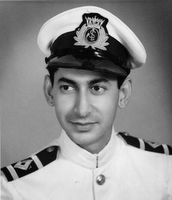
We are shown to a cabin which, though meant for 2+1, is spacious enough and the bistarband comes in handy. Soon, the ship's ropes are cast off and we move gently away from the pier. The air is suddenly filled with wave after wave of loud roars of Pakistan Zindabad and Quaid-e-Azam Zindabad. One can feel not just the passion but the freedom in those naaraas, suppressed at the pier where everyone realized that such slogans could incite riots. Once Bombay harbour begins to fade out of sight, Abi contacts the officer who is doing the rounds to inform him that he is a doctor and available for any emergency help that the ship's team might need. An hour or so later, he is called up by the captain and, with two other doctors and a couple of nurses also travelling as passengers. They are introduced to the Ship's Medical Officer and agree to do frequent rounds and assist with any passengers needing help.

At some late hour we are woken up by Abi to meet - and accommodate, if possible - a couple trying to find a comfortable place to rest. He has found them on his very first round. The bearded husband is none other than poet Bahzaad Lakhnavi. Some of you may be familiar with Begum Akhtar's rendition of his "Deevaana Banaana Hae To ..." Once a rangeen shaaer, Bahzaad Chacha later turned into a very prolific naat go, and now lies buried in Karachi with signs on the graveyard proclaiming his ishqé rasool. His unique tarannum was extremely popular with müshaerah audiences. The next 3 days of the journey are spent with him and Abi reciting ghazals to each other with a slowly increasing 'fan club' blocking the passageways. The day before arrival in Karachi is my 7th birthday. Bahzaad Chacha gives me a shayr as gift. The original, in his hand, has long been lost ... but I still remember the words:
Tüm ko tohfay mayñ aur kyaa dayñ ham?
Lo nayaa mülk ... Iss mayñ phoolo phalo!
Abbu Jan gets a small temporary house somewhere near Jackson Bazaar in Keamari and, later, moves into the large Customs Flats nearby. We live with them for a few weeks while Abi - almost penniless - does the rounds in Karachi in the hope of finding a suitable job in some hospital. He does not wish to re-join the Army and has applied for release. One day, quite by chance, Abi bumps into Swami Ji (as we always addressed him). He recognizes Abi as one of his fellow students at medical college. Abi learns that Swami Ji and two other colleagues run a charitable hospital - with free treatment for Hindus - under the Ramakrishna Mission. They are on the verge of leaving for India, after handing over the place to GoP (as evacuee property, I guess). The stock of medicines, good for about a year, is to be thrown out since transferring them to other hospitals is considered a major task of logistics and accounting. Abi is apalled. He says he would like to continue running the hospital, without charging the Mission, until all the medicines run out. He promises to keep it free for Hindus if the Mission agrees that the free treatment could also be extended to Muslim refugees who cannot afford to pay. They agree, but there is the Government to convince. Abi's old Aligarian friend, Mr A. T. Naqvi, now the Commissioner of Karachi, arranges for this to be formalized and, suddenly, Abi has a job which, though it carries no salary, comes - to our delightful surprise - with a small 2 room apartment on Nazareth Road (half-way between Guru Mandir and Soldier's Bazaar). We live next to the larger apartment occupied by Swami Ji and his colleagues. I am in and out of their house all day, devouring all the Idlees and Dossas and Rasm they can feed me - which explains my desire to dart off to the South Indian Sagar restaurant the moment I get to Dilli. (If you ever go there, be sure to try their almost-3-foot-long Paper Dossa.)
Diversion The Nazareth Road house is purchased the following year by a Nawab Hasan Yar Jang (nephew of the colourful Nizam of Hyderabad) and Swami Ji manages to have it written into the agreement that as long as Abi is alive he can continue to stay in that apartment, paying rent - of course. The Swamis leave in a few months. Nawab Sahab - always very civil when we encounter him in the building - shifts in with his 'lingerers on'. He gives me my favourite mithai - genuine Baadaam Ki Lauz - whenever he receives a package of it from Hyderabad. I even get to go with him and (What a treat!) sit in the Royal Stall to attend the Platinum Jubilee of Aga Khan III (grandfather of the present one), a ceremony Nawab Sahab is attending on behalf of the Nizam. But Nawab Sahab is a stickler for words. The contract says that my father can occupy the house as long as he lives. On 18th September 1963 my ship happens to arrive in Karachi. On the 19th my father dies. (Abbu Jan and Ammi Jan are getting a house built in Iqbal Town and are temporarily staying with us, which offers Ummi and me a bit of solace, since we have all been very close, always.) The Nawab attends the funeral, comes into the house to condole with my mother, and informs me on his way out that we have to vacate the house in 48 hours! Which is what I try to do, but it takes a bit longer and needs the good offices of neighbour, ex-Mayor Khan Bahadur Gabol Sahab, to convince the Nawab. I sail away two days after our hurried shifting. This trip to Karachi has been a life-changing experience for someone only 23 years old. But let me get back on track.
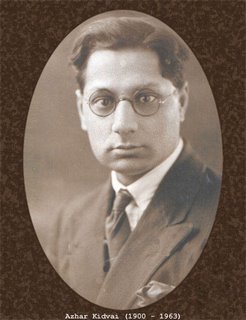
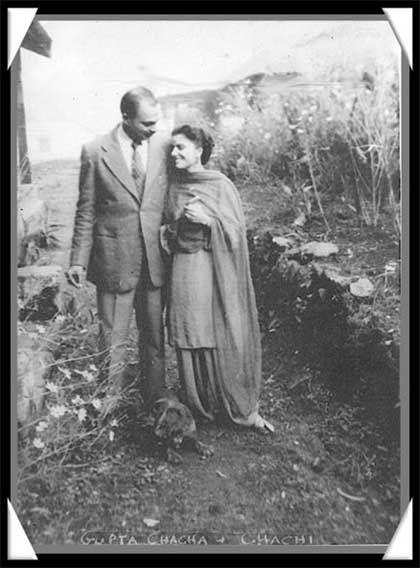
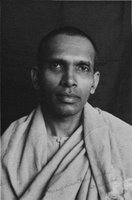
Gupta Cha is in touch by mail and we receive a picture of him and Chachi soon after their wedding in 1949 or 1950. This exchange continues, off and on. When Abi dies, Ummi receives a very warm letter from them, asking "Bhabiji" to stay with them in Dilli for a while. But the trip never materializes. We couldn't afford it. Then, for some reason - possibly mail going astray after the 1965 war - we all lose touch. For years I search for him ... but can recall neither his rank nor anything else. Whenever my ship is at an Indian port, I try to think up ways to find Gupta Cha. Trying to find a 'Gupta' in the Indian army, I am told, is just short of tracing the right 'Khan' in Afghanistan.
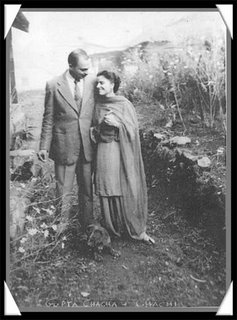
Zoom ahead to 1983: I am in command of a ship operated by the Gokals out of Hong Kong. The officers and crew of these ships are multinational and on my ship the Chief Engineer, Vipin Kaura, is from India. Vipin's father - a retired Army officer - comes from Dilli to visit our ship and stays there for a few days.
Soon after 'Uncle Kaura' arrives, I decide to go wish him. I plan to remember to say Aadaab in the old tradition but my Pakistani Radio Officer - a Lahori - tells me that that was not as common a greeting in Punjab as in Delhi and the U.P., so maybe I should say Namsté to be polite. I walk in and say that, a bit awkwardly, failing badly at the hand coordination for the accompanying gesture. Uncle Kaura - originally from Rawalpindi - says. "Aray ... hum to soach rahay thay keh bohat din baad Salaam Alaeküm sünnay ko milay ga ..." and soon the talk turns to his homesickness and losing touch with old friends. He regrets forgetting to write Urdu well.
During the stay I recount 'our' partition story and he asks me if there is anything I can recall about Gupta Cha that could help trace him. Apart from his first name, Birjesh, I usually can't recall anything. But from some hidden corner of my mind, that day, I bring forth two facts that I'd never consciously recalled earlier. Someone in Gupta Cha's family - possibly his father? - was a Judge. And they lived in a house called Bürj Mahal in Meerut. Before he leaves the ship and heads home, Uncle Kaura says he will ask some old colleagues about Gupta Cha but doubts if anything will come of it. Five days later, I am standing at the Shipping Agency office when I am handed an envelope posted from Delhi, addressed to me. I open it and discover a letter in Urdu in a shaky hand. It starts "Pyaaray Baytay ...". "How sweet of Uncle Kaura," I think to myself, "to try and write in Urdu after all these years." But the next para that I read (writing this I am still feeling the same sensation as I did then) is something I cannot believe. I jump ahead and look at the bottom of the next page. YESSSSS! It says "Tümhaara Gupta Cha". It takes me an interminable amount of time to absorb this. A clerk comes up and asks if I am OK. I have tears streaming down my cheeks and can barely speak as I read about Gupta Cha thinking each year of me on my birthday, admittedly not difficult to remember in India (It's Gandhi Ji's, too!). I read and re-read the letter. He wants me to fly out to Delhi. Of course I cannot (not just because of the visa but because we sail out in 2 days).
It turns out that Uncle Kaura, immediately on his return to Delhi, took a bus to Meerut and spent the day searching for Bürj Mahal. Unsuccesful at his attempt, he stopped at a shop in a multistory building to have a cold drink before taking the bus back. The shopkeeper and he got into a conversation and he mentioned his search for Bürj Mahal. "This very building is where it used to be," said the shopkeeper, "and the old owners live right on top, I think." So up climbed Uncle Kaura and met Gupta Cha's sister-in-law and told her the tale. She recalled our family and informed Uncle Kaura that Gupta Cha lived in Delhi! Defence Colony!! One lane behind Uncle Kaura's house!!! (Yes, Woody Allen. Life does imitate bad television!). So it is to Uncle Kaura that I owe more than I had realized.
After I regain control of my senses (and I am not dramatizing this ... it did take a while, as 36 years and all that's happened in that period ran through my mind) I immediately decide to phone him. And Ummi. Getting connected to Karachi, oddly, happens very quickly but I just manage to tell her that I've found Gupta Cha when, even more quickly, the line drops and we cannot get through again. Getting through to Delhi is a 'trunk call' - as calls between cities were then known - and requires a 'booking'. "It's about a 3-4 hour wait," says the operator. The manager of the agency, who, like everyone else in that room, has heard bits of my story by then, takes the phone from me and says something in Marathi, and then translates it for me. "Maeñ saalay ko bola 'Yeh jaldi type ka call hae! Death and Illness Emergency'. Abhee das minat mayñ mil jaae ga." Of course I can't recall the conversation with Gupta Cha. Too full of both of us trying to fill the other in about everyone and everything. Sobs. Laughter. He tells me he has two children. The son, nicknamed 'T2' is in the army. His daughter, Nanu, is married to Sunil who is in the Navy and is posted in Bombay. I am excited. "Can I see her?" Gupta Cha gives me the address of her house in the Naval Colony and, still reeling from all this, I am put on a rickshaw by the friendly clerk who first tells the driver my story and then instructs him to wait wherever I am going and bring me back later and collect the money from the office as part of the celebrations for my joy. Awwwww.

So off I go. Kinda stupidly quick response, if I'd just thought a bit. I can't even get into the Naval Colony in my own city without some identity papers. And, as a Ship Captain from Pakistan, I should not even be near an Indian Navy area. But who was thinking? In retrospect, I often shudder. Had I been arrested and charged with a Pak spy masquerading as an Indian, I'd still be in jail there, if alive. But I was not pretending about anything. I was excited and that's all that must have shown on my face. No nervousness at all. Just a stupid pasted smile of the kind that airline staff bear. The clothes, too, helped. I was in a white khaddar kurta pyjama - my usual dress code for the evenings - a common sight in Bombay, anyway. The chatty rickshaw vaala, who informed me that he was a Muslim and had relatives in Karachi, spoke to the guard when he asked where we were headed. "Aray chho∂o yaar ... 30 saal baad behen say milnay jaa rahaa hae sahab!" And we were in.
Later, I have laughed often at the thought that the Indian Naval Security services are at the same level as ours - recalling that in the 60s, when we docked in Karachi with ammunition that our ship had brought in from Iran, the whole port area was under security and passes were required to board the craft. Not even our own officers could step onto the quay and board the ship again without passes. Sitting in my room, I nearly leapt out of my chair as I saw an old friend from India walk in. "How the eff did you get on board? It's bloody tight security!" ... Bhagwan Das winked and said, "Full Paanch rupyah diya gate vaalay ko, yaar!" 

The meeting with Sunil and Nanu was great. It was like being at home with people I'd always known. No takallüf. They already knew of me. Their elder daughter, Ayeshah, (named by Gupta Cha) fell asleep soon but I did get to carry around the new addition, 4-month old Amrita, after eating a lovely home-cooked meal, so that Nanu could eat in peace. I wish the ship would have stayed longer so I'd have got to spend more time with them. For a year or so Nanu and I managed to stay in occasional contact, but Sunil was then posted to Vishikhapatnam, I think, and none my letters ever reached them, so we lost touch.

Gupta Cha and I wrote to each other often and I phoned him from several ports - Hong Kong, Singapore, from wherever I could dial direct. He and Ummi, too, exchanged a few letters (in Urdu!). He was insistent that I hop across the border and stay with him for a few days. "I have a room reserved for you", he'd always tell me. But visas were an impossibility for me then. I returned to Karachi in late March 1986 and Ummi told me that Gupta Cha had passed away just a couple of days earlier. Fate's cruel joke... to have found him after years and never met him! I spoke to Chachi on the phone. There was less to say except in silence. Some time later, I received a call from "T2", whom I had not been in any kind of contact with. His addressing me as "Bhaisaahab" seemed so strange. He told me they were letting go of the house and he was taking Chachi along to wherever he was posted then. Chachi came on the line - and in one of the most touching moments for me in this strange saga - asked me if it would be possible, before they left the house, to come and stay a day or two in the room that Gupta Cha had earmarked for me. I tried but I could not get the NOC needed for a visa. (Although I had left the sea - swallowing the anchor soon after my daughter's birth … and Ummi's accident that confined her to a wheelchair … and started a company of my own, my passport still showed Merchant Seaman as my profession, so our Ministry had to issue NOCs.) I never managed to contact T2 and Nanu again. Uncle Kaura, too, passed away before I could find out the address from where, maybe, I could get a forwarding address they'd left behind.
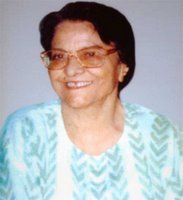
On my next trip to Delhi, much later, I told Vipin about trying to find T2 and, together, we called up several Guptas, none of whom could help. I discussed with Tarun (of Tehelka) the possibility of an ad in his paper looking for these people but we never got around to it.

Fast Forward: It's late 2007. I am sitting at T2F in Karachi and get a call from a Pakistani Merchant Ship Captain, some years junior to me. We don't really know each other. He is writing a book about our Merchant Navy and wants any photos that I may have which could be used. Then he says, "I was in Bombay last week at a meeting and there was someone who wanted to get in touch with you. I promised to trace your numbers and send them to him." I imagine it's one of my many Indian fellow seafarers from the NOL (Singapore) or GESL (Hong Kong) days. But it turns out that it's someone from the Indian Navy. "SUNIL?" I almost shout the question. "Yes." It's just too crazy! I get Sunil's number and call him up. Later, I speak with Nanu. I learn that Chachi is no more. None of us ever got to meet her :-( Then I get a Delhi number and call T2, whom I'd searched for as a Major? Colonel? Something Gupta. In all the years I was in contact with the Gupta family, no one had ever mentioned T2's full name! Turns out he is Pradeep Kumar. Chalo. And he's been living in Delhi for a few years (during many of which I've been visiting the place often, even for long periods). Much as I wanted to, I could not attend T2's son (and my fellow Merchant Navy Officer) Abhimanyu's wedding in Jaipur, where Ashmita's family live. Just a few days earlier that city had suffered from bomb blasts (obviously, the blame was laid at our doorstep, as is customary) so getting a visa to that city was out of the question. 
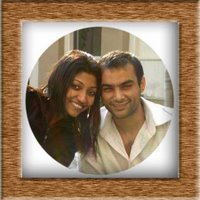
Things are getting better. T2 met our daughter in Dhaka during his business trip. I met him and his wife, Ruby, when I stopped over in Delhi en route to Kolkota for a meeting. Sunil flew over from Mumbai and we had dinner together. Nanu, I hope, will be able to come to Delhi the next time I am there (hopefully in the last week of the next month). And I am dying to see the kids all grown up.
 
If ever there could be a suitable postscript to all this, it's this email I received just a while ago. Peace!

Labels: , , , , , ,

The 'Other' Heresies

Mexican photographer Pedro Meyer is as renowned for his powerful and provocative photographs as he is for his pioneering work with digital imaging. Meyer’s photographs consistently test the limits of truth, fiction and reality. With the advent of digital photography in the early 1990s, Meyer evolved from a documentary photographer who created so-called “straight photographs” into a digital-documentarian who often combines photographic elements from disparate times and places to arrive at a different or higher truth. Pedro's oft-expressed contention that all photographs — digitally manipulated or not — are equally “true” and “untrue” has been labeled “heretical” in the orthodox documentary photography community.


While fellow Apple-user Pedro Meyer (one of the first to adopt this platform and launch the very first intearactive CD-ROM!) may have his exhibition - Heresies - opening in 60 museums in almost as many countries (we are thrilled that T2F, where the exhibition opens on 21st October, has been selected as the Pakistani venue).

There are others, like me :), whose photographs have also made it to some of the greatest (virtual!) halls in the world. Here are just 2 of my examples.

"Happy viewing", as the Senator said!
;-)

Nuzhat

Sabeen

See you at the real Heresies, where a selection of large original museum quality prints of Pedro's works will be displayed and changed almost weekly!

Please do keep checking out the schedule at T2F's website for the exciting related events, like workshops, talks, discussions, and presentations during the weeks that this unique exhibition is on, unless you're on FB and already visit T2F Pages for updates.

Oh ... did you know that you can also subscribe to T2F's Events RSS Feed so you get the news automatically? And, as the icing on the cake, sign up for SMS alerts and get timely reminders too. This saves you the task of 'remembering to remember' to go to the website and saves me answering calls - usually when an event is actually happening - Maddy, please note ;-) - about when and what time it's happening.

Labels: , , , , , , , , , , ,

A great leap forward

When my daughter screened her very first short film (Bindiya Chamkay Gee) - during one of T2F's Cinema for Change sessions - the star of the documentary was also the star of the evening, answering questions and countering comments (some rather accusatory) with a confidence that many had not expected. But then they had never met a Hij∂a like Bindiya!


  Among the post-event post-Q&A discussions that followed within small groups (and the place was buzzing) there was one recurring thought: Given the scale, number, and variety of problems developing countries face, it was a wild fantasy for Bindiya or her supporters to imagine that the difficulties encountered by such a small subset of the population would even be on the radar of the governments of any of the countries in the majority world (to use Shahidul Alam's term of choice). Some felt that the vote-bank was not large enough for any politician to try and woo. Others, that any decent politician (yes, it is possible, though admittedly rare) who truly wished to support such a cause would be mocked so much that he would lose his general credibility.

It was a joy, then, to see this news item from our 'neighbouring country' (a euphemism that our state media uses for India, lest the invocation of the actual name result in that evil genie materialising and devouring us).
DISCRIMINATED AGAINST and forced to live in secluded communities, India’s hijras have always had to fight for basic entitlements. Two weeks ago, however, a major victory was achieved when Tamil Nadu added a third gender to ration cards. Hijras may now enter a ‘T’ (for transgender) in place of a ‘M’ or ‘F’ on ration cards. The move makes Tamil Nadu the first Indian state to officially recognise its hijra citizens.
Incidentally, the article is by Morgan Harrington, who was at Hampshire College with our daughter. Read the whole story

Labels: , , , , , , ,

Tuesday, July 23, 2019

Dr Syed Mahmud


Dr Syed Mahmud, Jawaharlal Nehru, Khwaja Abdul Majeed

Dr. Syed Mahmud was born in Bhhitri (a qasbah in UP, India). He was educated at the Aligarh Muslim University. During his time at the University, he became involved in student political activities and attended the 1905 session of the Indian National Congress, the largest Indian nationalist organisation in what was then British-ruled India. 

Dr. Mahmud was amongst the Muslim students who opposed the pro-British loyalties of the All India Muslim League and were drawn more to the nationalist Congress. After being expelled from Aligarh for his political activities, he travelled to England and studied Law at Cambridge University before going on to study at Lincoln's Inn to become a barrister.

In 1909, in London he came in contact with Mahatma Gandhi and Jawaharlal Nehru. In 1912, he obtained Ph.D. from Germany and came back to India, and from 1913 he started his legal profession in Patna under the able guidance of Mazharul Haq. In 1915, he married Mazharul Haq's niece. After practising law for a few years, he was soon drawn into the strengthening movement for India's independence.

In 1931 the Congress Party held a session in Karachi. There were roads named after the people who attended. Motilal Nehru Road later became Jigar Muradabadi Road (although Jigar was an Indian, too). There were smaller roads leading from Motilal Nehru Road and some had Muslim names that were not changed by our Government.

Dr Syed Mahmud Road was one of them. Many years later someone remembered that he actually lived in India and changed that road name, too.

Nana Jan was the Joint Secretary in the Congress Party for 16 years with Motilal Nehru and remained a very close friend of Jawaharlal Nehru. After India’s Independence he became the Foreign Minister and also visited Karachi which was the capital of Pakistan, then. I was extremely fond of him as he was of me.

My father's book of essays, short stories, and a play were items that he wrote between 1926 and 1931 and they were published under the title Naee Paod. (Just to get you what the prices were in those days: There were 1000 copies printed and it was priced at Rs 1). The book was dedicated to Nana Jan.

I always called him Nana Jan.
Nuzhat's mother was treated by my father as his young sister.

Nana Jan with Nuzhat and Khalid (who died so early) •
Nana Jan also appeared at Nuzhat and my wedding.
He seemed so old since I had last seen him.
Nana Jan with Nuzhat's mother (Jan Mammi) •
Indira Gandhi was a close friend of Jan Mammi,. She flew out of Karachi on Pandit Ji's death and remained with Indira Gandhi to carry Pandit Ji's ashes after his cremation.

Labels: , , , , , , , , , , , ,

Thursday, June 20, 2019

Sabeen: A Letter and a Tribute

An old letter from Sabeen on one of her birthdays

Page 1


Page 2

Click on the letters to see them in readable size

•

'You refused to cower in silence': A letter to fallen Pakistani comrade Sabeen Mahmud

Beena Sarwar  · Yesterday · 08:15 am
Dear Sabeen,

Photo: Zaheer A. Kidvai
Old friend, comrade, upholder of all kinds of freedoms, lover of tehzeeb, Faiz, Eqbal Ahmad, qawwali and stray animals…

Must we write about you in the past tense?

I'm trying to remember when we first met: Karachi, in the late 1980s after I returned from college. Ammi’s friend Zaheer Kidvai who I had a rapport with introduced us. He refused to be called “uncle”. He was always just Zaheer (later Zak) – not just for me, but also for you, ten years my junior.

Zak, the maverick former merchant navy techie brought new ideas about education and technology to Karachi. He introduced Apple computers to Pakistan and took you under his wing. He saw your potential and roped you in to his zany, maverick world. You and Zak: my two die-hard coffee-loving Mac junkie friends – Zak is Zakintosh in some social media accounts.

On Saturday, his own frail health notwithstanding, he attended your funeral, the funeral of his adopted daughter. Zak’s wife Nuzhat, a fiery activist herself, has been solidly by your mother’s side in hospital as they operate to get the bullets out. A single mother with an only child. It was too late before they even got you to the hospital.

The funeral, appropriately enough, left not from your house but the place you made a home for yourself and so many others: The Second Floor, community space, coffee shop, bookstore and art gallery.

How many initiatives have we been together in since the 1990: Peace Action Karachi, People’s Resistance, Citizens for Democracy, Citizens for Free and Responsible Media, to name some. You were on the board of Madanjeet Singh’s South Asia Foundation, and among the Young Leaders network of Asia Society. I remember our excitement when South Asia Foundation invited us to Srinagar – and then the letdown when we didn’t get the visas in time.

I had fun filming my Kashmir documentary Milne Do at T2F’s old premises, with Asim’s mural on the wall: you, Basharat Peer, Saad Haroon.

There was that amazing Social Media Summit you organised in Karachi a couple of years ago, for which you flew in Indian participants. Uncomfortable with being in the limelight, you pushed me into introducing the first session and the last-minute concluding press conference with interior minister Rehman Malik. How it amused you were when people assumed I had organised it. You never wanted the limelight or to take credit – a rare quality especially in an age where everyone wants to be a star.

A numbing shock

News about Sabeen Mahmud being shot dead hit like a bolt from the blue on Friday. Friends around the world, particularly in our home city Karachi, are shell-shocked.

“How many will they kill?” asks one person after another. Many cry uncontrollably.

I call Jibran Nasir, the lawyer-activist who is in the US addressing campuses and communities around the country. Sabeen was his mentor and friend, and one of the founders of Pakistan For All with him. They had formed human chains around churches after the bomb blast at a church in Peshawar in 2012 and were fighting for an inclusive, democratic Pakistan.

Jibran was in the middle of a presentation at Columbia University in New York when texts started coming in about Sabeen. Although shocked and grief-struck, he is resolute about taking forward Sabeen’s legacy of speaking out. He plans to start all his upcoming talks with Sabeen so “Pakistanis in America can see what a gem we lost”.

Some hours later, I speak to Zak – by then it’s early morning in Pakistan. He’s just come home from the morgue and the hospital. “I haven’t cried yet,” he says. Or slept, obviously. He's been dealing with all the formalities, including police reports.

According to some reports, the police are trying to pass the attack off as a robbery attempt. No one’s buying that. Five bullets – in the chest, neck and face – the last one going through and hitting Sabeen’s mother Mahenaz, who was hit with other bullets too.

She’s numb too, says Zak. She’s been operated upon, and all but one bullet removed which they couldn’t find. She knew that Sabeen was no more when she called out to Sabeen and took her hand after the bullets hit.

They were in their car at a signal from where Zak and his wife Nuzhat had just turned left, going ahead for dinner somewhere. “We’d barely reached the next signal when Mahenaz called saying, ‘Come back, we’ve been shot,’” says Zak.

Two clean-shaven young men on a motorbike had pulled up and fired at Sabeen, who was driving, her mother next to her, the driver at the back.

Driver at the back? Why?

“Sabeen se koi kaun poochta kyun,” says Zaheer. I can hear the smile in his voice. “She did what she wanted.”

Mercifully, Sabeen died instantly. As she slumped over, they fired another shot into her back. Then they took off.

Passers-by helped get Sabeen into the back seat. The driver took them to the nearest hospital. Zak and Nuzhat reached a minute later. Nuzhat took Mahenaz to the Agha Khan hospital across town. Zak stayed with Sabeen, pronounced dead on arrival.

Engage, always engage

They had been on their way back from a well-attended event on Balochistan at the arts-café-community centre The Second Floor – a project of Sabeen’s non-profit Peaceniche started in partnership with Zak. The idea was “to promote democratic discourse and conflict resolution through intellectual and cultural engagement”.

T2F has over the years become a hub for the arts, “a community space for open dialogue” with a coffeehouse, bookshop, an exhibition gallery and a staff that adored Sabeen. It didn’t matter what religion they were or how young or old. Though straight-talking and direct, refusing to suffer fools, she treated everyone with the respect and courtesy, especially those at a social or economic disadvantage.

How many writers have had their first readings or launched books at T2F, filmmakers premiered their films, artists displayed their works, singers, musicians and playwrights shared their talents.

And political discussions. T2F was a hub for discussions about the political dissent that grew around General Musharraf’s Emergency imposed in 2007. When Sabeen learnt that a young, unknown lawyer named M. Jibran Nasir was running as an independent in the 2013 elections, with just Rs 50,000, she got in touch, heard him out, then put her full faith in him. For the next five weeks, he could use T2F for her corner meetings and campaigning – at no charge.

Most importantly she gave him a voice. Just as she gave a voice to anyone who needed it – Ahmadis, Shias, and Baloch – to anyone who felt oppressed or needed to vent and “to let out their anger”, as Jibran puts it.

For him, “Sabeen was a guide, mentor, teacher, facilitator, enabler, catalyst."

As he reminded me when I called him, “Sabeen’s legacy was to speak out. Her legacy was not to cower in silence.”

That is why she agreed to host an event at T2F on Balochistan, featuring activists like Mama Qadeer, Farzana Baloch, and Mir Mohammad Ali Talpur. They’re among those who have been highlighting the case of the missing persons of Pakistan’s least-developed province, but richest in mineral resources. A province wracked by a separatist uprising stemming from a demand for equitable treatment and a share of their own resources; resources that Pakistan has recently signed an agreement with China to develop. (Besides the $485 billion, a bonus is that “China knows how to curb insurgents”, as a brigadier told a friend recently).

Holding open discussions on Balochistan is pretty much a no-go area in Pakistan. Geo TV’s Hamid Mir was shot at last April after he had been speaking out about exactly this. The fallout from the episode led to Pakistan’s largest media group being brought to its knees.

Just a month ago, one of the country’s premier educational institutes, the Lahore University of Management Sciences cancelled a seminar titled “Unsilencing Balochistan”, featuring the same speakers who attended and addressed the T2F event, citing pressure from the government.

And yet when the young organisers approached Sabeen to hold the event there, she agreed despite the risks, the threats, the misgivings, all of which she was very aware of. She knew the risks she ran:

Another discussion on Balochistan is scheduled on May 6 at Karachi University. Will it take place now, is the question.

Already the disinformation campaign and character assassination has begun from those I call the Dirty Tricks Brigade (#DTBPk), just as it did after the attack on Hamid Mir and the cancellation of the LUMS seminar.

After Sabeen’s murder, “those who feel scared and cowed, and feel they should not speak out because it’s too dangerous, there would be no greater insult to Sabeen’s legacy if you do that”, says Jibran. “If you loved her, loved her work, loved the issues she loved, keep speaking out and raising your voice. We must do this to fulfil the dream of the Pakistan that Sabeen dreamed of, a country where there’s no discrimination in the name of religion, language, ethnicity or any pretext.”

The bullets pumped into Sabeen may have silenced her physically, but her legacy lives on. Her many admirers, friends and fellow-travellers will not let it die. For a start, here’s the link to the Tumblr site created as a tribute to Sabeen by friend and fellow techie Sabahat Ashraf that friends and followers can contribute to.

Photo by Rez
•

Labels: , , , , , , , , , , , , , ,

Wednesday, January 09, 2019

Education IS Expensive

Chief Justice Saqib Nisar
With so much going on about the soon to be ex-CJ's orders about schools, I received this from a school. Well worth a look. 


•

The Government should improve its schools … but that seems impossible with no students and lots of teachers in some places, no schools at all (ghost schools) in some areas where salaries are being drawn, no actual buildings or even remains of them where money is being given for work in building it and maintaining it, with money even being paid to 'remove' a school which never existed. I got most of this from Anita (Ghulam Ali) Apa, a leading Educator in Pakistan. 

The fact that Private Schools do all this to prevent Government Schools from functioning is a gross mis-statement. Many private schools have even tried to help some Government Schools run better (and that included Railway Schools, as an example) by offering them many services. However, that didn't last long, either, because the Private run schools were not allowed to fire any teachers who did not come at all: It was the Government's job to fire them (which they did not do).

I realise that with inflation and several children (Preferred: don't have more than two kids!) it is impossible to go to schools where the fee is higher than parents can afford. But they do have a choice: Take them out of that school and send them to a lower fee school.

Listen: Many can't buy a Louis Vitton Bag so they choose a lower priced bag; many can't eat at Okra so they go to cheaper restaurant like McD; many can't use airplane tickets to go to see their child in USA (I certainly can't, except once in a year, when I could easily take 3 trips to USA earlier when I worked), so some wait for two years, now.

But what is the parents argument? I need the same education that the top schools provide but I will pay what the lowest fees is in the lower schools.


Remember this saying by the President of Harvard
(where many parents want to send their kids)


Labels: , , , ,

Thursday, November 08, 2018

There is a reason to support T2F …

Sabeen Mahmud, born 20th June, 1974, was assassinated on 24th April, 2015 by those that hated Pakistan.


She was marvellous in every way. I knew her for 26 amazing years as a Student, as an amazing Colleague, as a Friend, as a member of my Extended Family, as a Mentee, and as a Mentor!

I was in the car behind her a few seconds later, after the event at T2F, and had just turned left when she was shot. I was at the hospital when she was pronounced dead.

Sabeen started T2F (The Second Floor - since it was on that floor where she opened it).. There were 6 other founding members and I was one of them*.

The concept behind T2F - a not-for-profit NGO, was to have a place to sit and chat and discuss things with others that one rarely, if ever, met otherwise. 

One object was supposed to ensure that guns and violence would end. People would listen to others. Discuss and talk about their views. Learn from each other. At least be willing to understand that in a free country there were going to be 'other' views, too … and, if not agreeing with them, one could allow them to exist. Or change them through discussions.

In most cases ARGUMENTS meant FIGHTS; T2F felt that DISCUSSIONS promoted UNDERSTANDINGS.

The exhibition space of T2F was meant for Large Discussions, Qavvaalis, Music, Book Launches, Science ka Adda, Urdu Preservation Project, Arts, Performances, Photography Shows, Plays. Even courses or small discussions helped many people to share their ideas. People from around the world have spoken or performed at T2F. 

There have been many other things that T2F has done: Creative Karachi Festival at Alliance Francaise (another one coming up shortly!), T2F supporting SOT recently at Beach Luxury, and many more.

Internationally it held Dil Phaink in London - a large exhibition of taking Karachi to London! It won an Award from Prince Claus Funds in Nederlands.

When Sabeen was assassinated, major newspapers and events around the world - from Universities to the main road events - mentioned her, wrote articles about her, featured her in books, and even composed music about her.

All this has survived, often with great difficulty, for 11 years now. Most of it through support by its fans. 

You must understand and believe that supporting T2F is a tribute to the greatest public place in Pakistan. Drop a tip when you attend an event. Whether it is a rupee or thousands, in cash or by bank account. It needs your support to go on.

If you are into Qavvaalis, do go to the Arts Council T2F Fundraiser with Fareed and Abu. Tickets are Rs 2000 each and the evening will be truly great.

*
I left T2F after Sabeen's death …
for working without her seemed impossible.

I rejoined as Director when Khalid Mahmood took the place over from Sabeen's mother, who found it difficult to carry on working there through this terrible tragedy. KM and others wanted a person there who had been part of the original team.

Having left the Directorship on the 1st August 2017, I stayed on as Executive Director until we found Arieb Azhar who joined us and then I left the place, finally.

But only 'officially'.
T2F is part of my life and will always be
the centre outside my own house.


Labels: , , , , ,

Sunday, September 16, 2018

A Place of Learning


Well, yes. I know that's difficult right now. Too many pressures. Not enough alternatives available. And the Governments in the Majority World don't really want their children educated: Why would an educated person vote for the ones that are now in Power.

•

Learning is something we all do. Every day. From the time we are born to the time we die … though schools do lessen the habit and sometimes completely take it out. The Forces, of course, ask you to leave that habit outside when you join them and make you do whatever the Command says you must. Remember: Enemies become friends and change back into enemies as the Governments feel.

Education may, at one point, have meant the same. In some Universities it still does — though it seems to be changing about who you can invite as guest lecturers. Anyway, that was before Governments altered Histories and ever-changing goals, with no allowances to discuss alternatives or different views. Soon Corporations got on and even started adding books with heavy corporate ideas into the books. What? Well, look at the Math book with 'a little help' from McDonald's.

•

At my schools (I started mine at 7 years and changed into 4 of them … but for goodish reasons), I was regarded as an average student. I passed my Senior Cambridge in 1956 in the Second Division with one A, five Bs, and an F in one subject.

Most teachers (though I must admit that Messers D'Souza, Nazareth, and Chohan, didn't agree with them) thought I was not a good student at all … while I thought I was being forced to learn subjects that were of no interest to me. I adored Maths, Physics, Literature, Urdu (as a First Language. No, not the Second Language that was really crazy). If the subject was of my interest, I really could do well. If not, it was nearly a Zero …

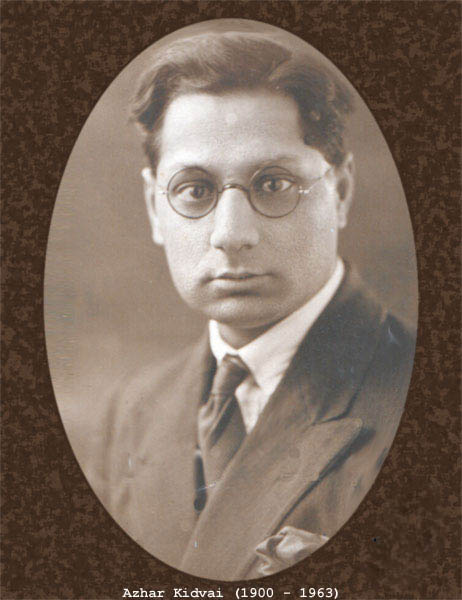
Part of my loves of these subjects came from my father, Azhar Kidvai, who was a Medical Doctor and an Urdu poet … and even sang reasonably well (something I couldn't do, how hard I may have tried). The love of Maths came from his engineering father, Safdar Ali Kidvai, who changed my near-zeros in that area to an ardent love in the 4 months that he was here for his operation.

My memory was good: I could go to a Mushaérah and come back remembering most of it and recite my favourite shayrs to my mother. But I could not use my memory to learn and regurgitate things that I had no interest in. And that has become the most important thing these days in schools.

My tastes were varied. I loved Music: Western Classical, Eastern Classical, Jazz, and great Pop. I adored films, from the Silent ones to the latest - if they were really good. I worshipped Comics and felt that some of them were like pieces of Art. But I guess they were not — until Joe Sacco appeared!!! I adored books. Read a lot of them. You'll be able to see most of these in a Library that wants to use the books, music, films and more for the public. It should happen in a year, I hope.

•

In 1957-58 I went to two colleges. Thrown out by the first one in Lahore for reasons that they knew, I joined another one in Karachi … and walked out of an exam, running away (despite being an only child and much loved) to join the Merchant Navy. (More on the walk-out and going ships in another blogpost.) 

Once I became a Junior Officer on the ships, I started to teach Cadets who came from colleges, some even with a degree in Maths. They knew very little … and, invariably told me they'd forgotten most stuff after exams (which had happened less than 6 months before they joined us). I had to teach them Maths and a lot more. Most of them were joining the Merchant Navy to see the world but couldn't pick out countries in a world map. 

I felt that these students, too, had been taught 'wrongly' (like I was) … but how could one say this with any assurance? So I started to try and understand Education and Teaching.

Having read several books from the greats: Russell, Dewey, Piaget, Freire, Kohl, Kohn, Postman, and many many more (see the lists of some of these at the end of this post) … I soon also met the BBC B Computer in January 1982. Wow! Later I also added an Apple IIe. Both went away after I got a Macintosh in 1984.

BBC B Micro


All of these taught me how much Education could be supported by these technologies. So I started a computer company (the first Educational Computing company in Pakistan: Solutions Unlimited, now run as a consultancy by my wife, Nuzhat Kidvai). The computer companies went further ahead. First I opened Enabling Technologies - a multi-medea company (which was later run, independently, by my once-partner Jehan Ara, now heading P@SHA and Nest I/O). Finally, BITS - a venture that began as a collaboration with BSS in Lahore and me in Karachi. Later on the Lahore BITS stopped, because they wanted to continue to serve their Education base.
(Sabeen Mahmud was part of this from the time she was almost 15 years old until a few years later she became my full-time Partner at BITS. I was with her when she formed T2F … and BITS became a net-based consultancy. The day she was assassinated, after a session at T2F where I was also present, our car was only 10 seconds away from her when her mother phoned and said they'd been shot.)
For those who believe having no real Education is terrible,
believe me, it's not!
As long as you get into something you really love.

Listen!!!

Having no academic experience, I was called to seminars to speak about Education and my sickness of it having turned into what it now was. I spoke at IBA (Karachi) several times, spoke at several schools, taught at Karachi's Teacher's Resource Centre, went to Apple Conferences, taught teachers from Kuwait at the Melbourne University, attended schools to see what Windows did in Education (almost nothing!) versus Apple that did a lot of what students and I loved. But, of course, Windows machines were cheaper and forced Teachers to teach nothing of Education, except Computer Science, initially. Visited MIT and worked in a Conference that was run by Nicholas Negroponte. 

I met and worked with Seymour Papert and spent a lot of time with Roger Schank (whom I have had come over to Pakistan many times). At Hakim Saeed Sahab's insistence — he changed the requirement of being a PhD to head a Department and said 'PhD or equivalent' — I headed the first New Media Department in Pakistan at Hamdard U and taught there for three years. The course that I taught, because I insisted that it be vetted, was accepted by a Canadian University as being a good course.

I am a Consultant to Beaconhouse School Systems for who knows how long. I have helped them open up TNS (The New School) and taught teachers there. I also worked with them to start the Beaconhouse National University — which is an NGO and gives them no money, unlike what many people think. The School of Learning has had me for many talking sessions and Cedar College has me on their Board of Advisers.

So it works.
Drop Out if you must.
But do Drop In and love what you do.

•

My talks at all of these, whether teaching teachers or students, had always included several things that I thought were essential - unlike the people who put their money into building schools (and, often, secretly accepting my views). Here are some of the things I talked about from 1989 to 2009 in my presentations, lectures, workshops …

* Grades are Degrading *

* Let's get back to the One-Classroom Schools *

* Life isn't about 45 minutes for each item —
so why do we have 45 minute periods? *

* Power tends to corrupt,
PowerPoint corrupts them completely. *

* A country's Geography decides its History:
Why two subjects? *

* There should be no Competition. *

* Let children learn by doing. *

* The Story-Based Curriculum is the best bet. *

* Children are different.
Schools want them to be the same. *

•

I must admit that many feel changing schools to useful places - to teach children how to learn forever and improve their lives - is too difficult to do. This is true because they are pressured by book-selling companies and some amazingly funny educators*, hardware companies that want boxes to be put out, parents who think they know education because they went to a school or college, teachers who think that because they have done this for years they truly understand today's kids (and write stupid reports that always seem to say 'could have done better'), and the ones that only do this for finances: The is why Dr Eqbal Ahmad called such schools "The McDonald's educational equivalent" at a conference in Karachi. (Do visit eacpe.org and learn more about the world.)

We need Parents/Teachers trained about Education/Learning and to understand that they are training children for a future that they know very little about. A child who enters a school today will not have many of the jobs that we work with now when s/he comes out of School or College. In their lives they may even have to change jobs several times and relearn things or understand several new ideas. Many children will drop out of Education to do things that parents couldn't have even thought of. Non-formally educated kids can now go into many major companies if they can do stuff that schools never teach.

Don't forget this: At the end of their school career the child scores an A (actually too many A's, now), having spent days at school and then paying more than the school fees to Tutors. The Schools take out glorious ads saying this is what we did to the students. Baaah … How about placing pictures of the failed kids who were with you for years and this is what you did to them!


•

The trend that I love most is Microschools. Read this and get to know more about them. It is absolutely essential if you are a parent. Or even a student. While the UK started this, take a look at Brooklyn, NY, where many such schools are happening. Go here.

•

Recently, thanks to a friend, Jawad Ali, I came across Portfolio-School.  It's a school in New York run by Babur Habib (from Karachi) and Doug Schachtel … and it made my day. I hope to go there and see the school and enjoy myself thoroughly. This would be a great gift to me just after my 78th birthday. You must visit their website. Go there now.

•

In November we have a great conference in Karachi. It's at the Beach Luxury Hotel, 3rd/4th November. SOT's Conference this time is called The World of the Future - Reimagined. Loads of people are coming in from worldwide as well as Pakistan (and India, too, if they get their Visas). They'll look at how the world is shaping up in all directions, discuss numerous subjects, and the impact that they'll have in the future of Education, as well.


And Babur Habib will be there, too.


•
Some SOT Conference details are here for you. The following five, broadly-overlapping dimensions will be explored:
* A Symbiotic Future (focal points: artificial intelligence in governance, fourth industrial revolution, effects of technology on concepts of gender, human sexuality & reproduction)

* A Balanced Future (focal points: sustainable economic development, environment and climate change, gender, minorities, the end of poverty and the future of humanity)

* An Expressive Future (focal points: art as a universal language, the role of visual and performing arts in effecting change, global vs. local languages, freedom of expression)

* An Inclusive Future (focal points: unity through diversity, inclusion of the economically disadvantaged, learning differences, gender bias in education, sports and other pursuits, non-binary gender issues, barriers for change)

* An Unknown Future (focal points: safe learning spaces, personal security and data security, navigating a world increasingly under surveillance, new directions in science)

•

Enjoy!

•

Go to Amazon and look for these people.
There'll be tons of books by them that you'll love.


•

Finally, a couple of interesting notes for you.

* Book Publish Companies
&
An Educator

Just a couple of small thoughts. Roger Schank and I were discussing (after the first SOT Conference) the possible future of today's schools. Both were against what the schools taught. We thought they should end soon if we can get around the pressures. The Head of a major publishing company in Pakistan was with us and said this is a ridiculous idea. What would her company do? As if we had put up schools to ensure that her company succeeds over what children needed.

She also added that children would get to talk to each other in schools (not that they don't in their mohallās!) … and I though that if they ever did that in the class, the teacher would ask them to shut up, since it "is not a playing field. Break is the time …"

•

The same night we had a dinner at the host's house where I asked a really senior, fully qualified, educator (who was about to head a University shortly) if he ever needed Pythagora's Theorem in his everyday life — since he thought Roger's idea was stupid. He said "yes; I always do."

This was (not verbatim but almost accurately) his answer: Whenever I come to a triangular patch in a field where I could go straight and then turn right to get to my destination, I think of the Pythagora's Theorem and work out that it would be easier to cross the patch at an angle because it would be shorter. (Hmmm!)

•


Labels: , , , , , , , , , , , , , , ,