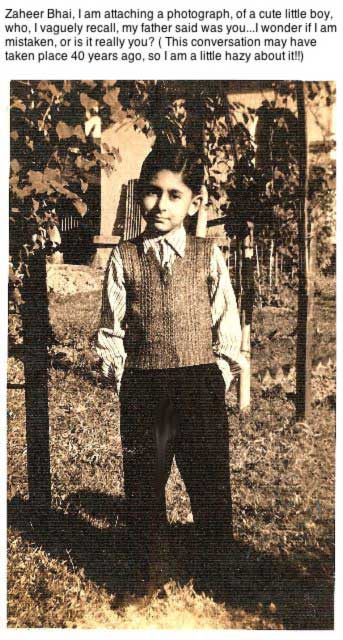
India 4: An uncanny tale ... (Part 2 — The Conclusion)
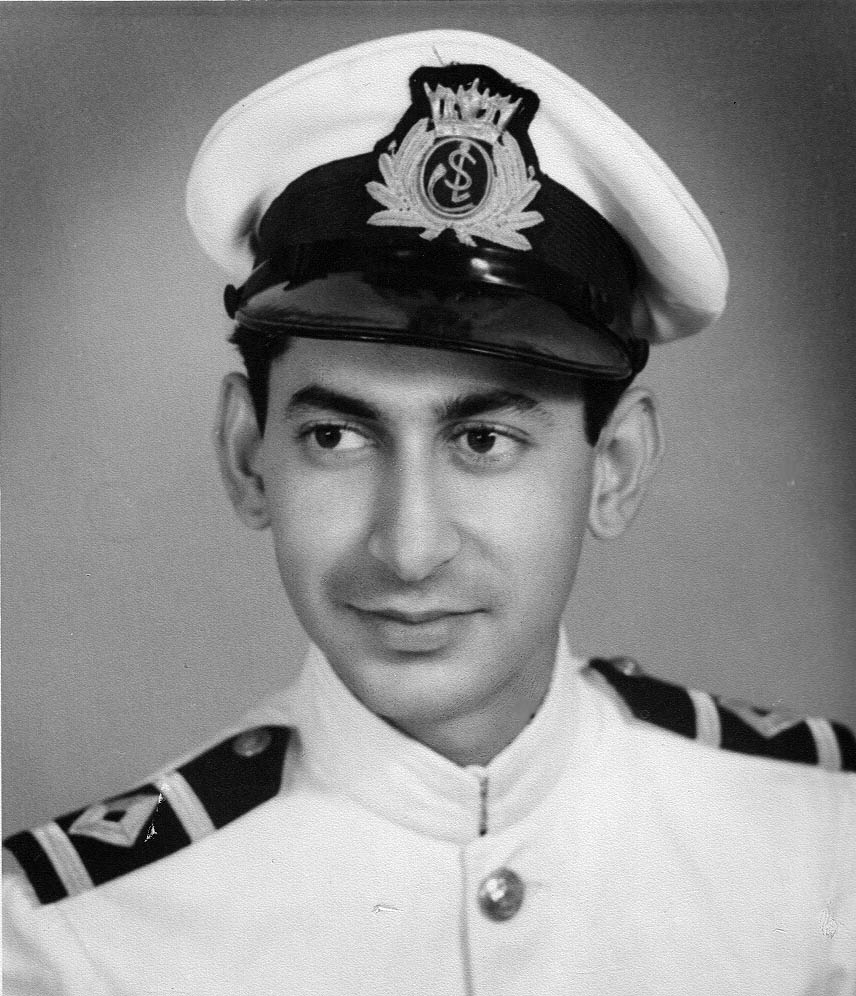 When you have had the benefit of a 25-year stint at sea (1959-1984), there is bound to be much that is narratable and shareable, with some of it even of interest to a few people outside your immediate family. But this post is, primarily, about Gupta Cha (and his family) - so I shall make only brief references to the other parts which will be covered in greater detail in "Ships and Shoes and Sealing Wax" (if that "book+" ever gets completed).
However, as indicated at the end of my previous post, the real conclusion to the tale - which took place last year - will make up the second half of this post. The first will be spent breezing through the intervening years.
When you have had the benefit of a 25-year stint at sea (1959-1984), there is bound to be much that is narratable and shareable, with some of it even of interest to a few people outside your immediate family. But this post is, primarily, about Gupta Cha (and his family) - so I shall make only brief references to the other parts which will be covered in greater detail in "Ships and Shoes and Sealing Wax" (if that "book+" ever gets completed).
However, as indicated at the end of my previous post, the real conclusion to the tale - which took place last year - will make up the second half of this post. The first will be spent breezing through the intervening years.
 There's a mad rush wherever one casts an eye. If I had known of the concept then, I would probably have thought of Maedaané Hashr. The sounds of bawling from families being separated can be heard mingling with the shrill laughter of children running everywhere, excited by the journey.
 but now seem more interested in Chacha Jania (Talat Mahmood) whom they have cornered. As usual, he is too shy and polite to get away from them, though he wants to join us for parting hugs. The very moment that we start up the gangway, he runs towards us and the Sikhs shout out to all, "Yeh Talat Mahmood bhaaga jaa rahaa hae Pakistan. Roko. Roko." The laughs lighten the sad moment. \
Abbu Jan gets a small temporary house somewhere near Jackson Bazaar in Keamari and, later, moves into the large Customs Flats nearby. We live with them for a few weeks while Abi - almost penniless - does the rounds in Karachi in the hope of finding a suitable job in some hospital. He does not wish to re-join the Army and has applied for release. One day, quite by chance, Abi bumps into Swami Ji (as we always addressed him). He recognizes Abi as one of his fellow students at medical college. Abi learns that Swami Ji and two other colleagues run a charitable hospital - with free treatment for Hindus - under the Ramakrishna Mission.Tüm ko tohfay mayñ aur kyaa dayñ ham?Lo nayaa mülk ... Iss mayñ phoolo phalo!
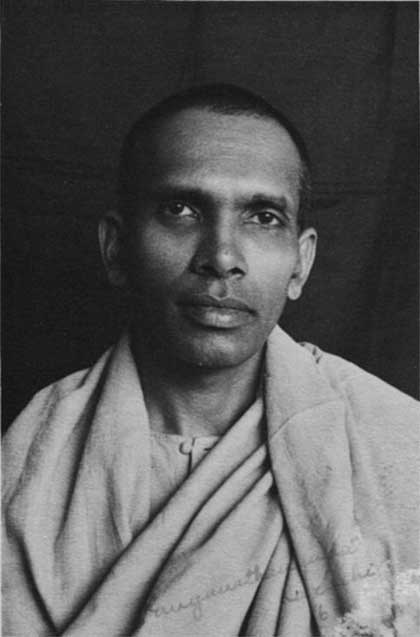 They are on the verge of leaving for India, after handing over the place to GoP (as evacuee property, I guess). The stock of medicines, good for about a year, is to be thrown out since transferring them to other hospitals is considered a major task of logistics and accounting.
Abi is apalled. He says he would like to continue running the hospital, without charging the Mission, until all the medicines run out. He promises to keep it free for Hindus if the Mission agrees that the free treatment could also be extended to Muslim refugees who cannot afford to pay. They agree, but there is the Government to convince. Abi's old Aligarian friend, Mr A. T. Naqvi, now the Commissioner of Karachi, arranges for this to be formalized and, suddenly, Abi has a job which, though it carries no salary, comes - to our delightful surprise - with a small 2 room apartment on Nazareth Road (half-way between Guru Mandir and Soldier's Bazaar). We live next to the larger apartment occupied by Swami Ji and his colleagues. I am in and out of their house all day, devouring all the Idlees and Dossas and Rasm they can feed me - which explains my desire to dart off to the South Indian Sagar restaurant the moment I get to Dilli. (If you ever go there, be sure to try their almost-3-foot-long Paper Dossa.)
They are on the verge of leaving for India, after handing over the place to GoP (as evacuee property, I guess). The stock of medicines, good for about a year, is to be thrown out since transferring them to other hospitals is considered a major task of logistics and accounting.
Abi is apalled. He says he would like to continue running the hospital, without charging the Mission, until all the medicines run out. He promises to keep it free for Hindus if the Mission agrees that the free treatment could also be extended to Muslim refugees who cannot afford to pay. They agree, but there is the Government to convince. Abi's old Aligarian friend, Mr A. T. Naqvi, now the Commissioner of Karachi, arranges for this to be formalized and, suddenly, Abi has a job which, though it carries no salary, comes - to our delightful surprise - with a small 2 room apartment on Nazareth Road (half-way between Guru Mandir and Soldier's Bazaar). We live next to the larger apartment occupied by Swami Ji and his colleagues. I am in and out of their house all day, devouring all the Idlees and Dossas and Rasm they can feed me - which explains my desire to dart off to the South Indian Sagar restaurant the moment I get to Dilli. (If you ever go there, be sure to try their almost-3-foot-long Paper Dossa.)
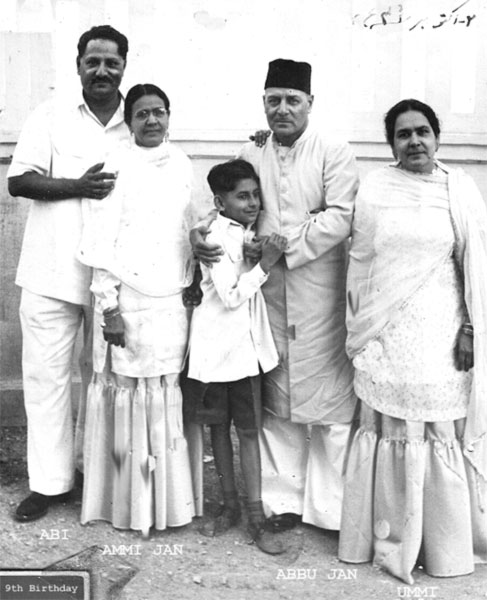
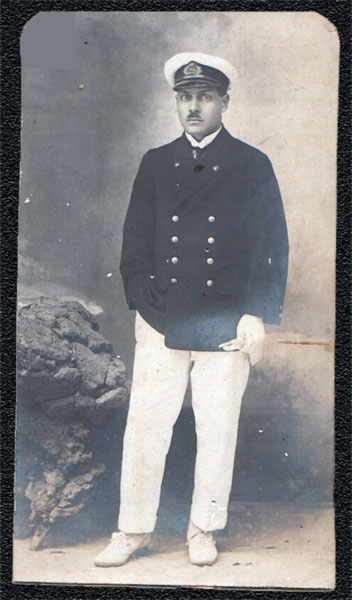
Diversion The Nazareth Road house is purchased the following year by a Nawab Hasan Yar Jang (nephew of the colourful Nizam of Hyderabad) and Swami Ji manages to have it written into the agreement that as long as Abi is alive he can continue to stay in that apartment, paying rent - of course. The Swamis leave in a few months. Nawab Sahab - always very civil when we encounter him in the building - shifts in with his 'lingerers on'. He gives me my favourite mithai - genuine Baadaam Ki Lauz - whenever he receives a package of it from Hyderabad. I even get to go with him and (What a treat!) sit in the Royal Stall to attend the Platinum Jubilee of Aga Khan III (grandfather of the present one), a ceremony Nawab Sahab is attending on behalf of the Nizam. But Nawab Sahab is a stickler for words. The contract says that my father can occupy the house as long as he lives. On 18th September 1963 my ship happens to arrive in Karachi.Gupta Cha is in touch by mail and we receive a picture of him and Chachi soon after their wedding in 1949 or 1950.On the 19th my father dies. (Abbu Jan and Ammi Jan are getting a house built in Iqbal Town and are temporarily staying with us, which offers Ummi and me a bit of solace, since we have all been very close, always.) The Nawab attends the funeral, comes into the house to condole with my mother, and informs me on his way out that we have to vacate the house in 48 hours! Which is what I try to do, but it takes a bit longer and needs the good offices of neighbour, ex-Mayor Khan Bahadur Gabol Sahab, to convince the Nawab. I sail away two days after our hurried shifting. This trip to Karachi has been a life-changing experience for someone only 23 years old. But let me get back on track.
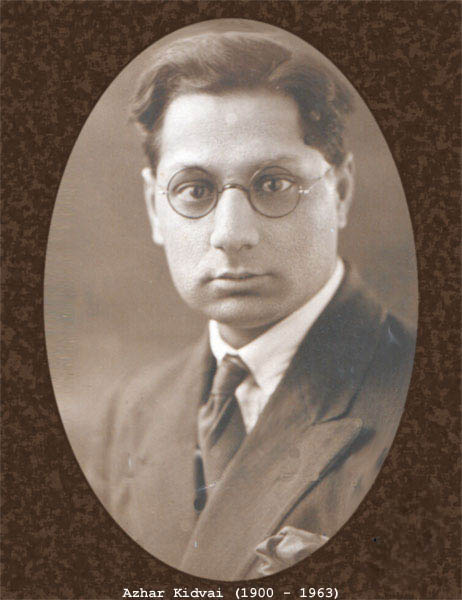
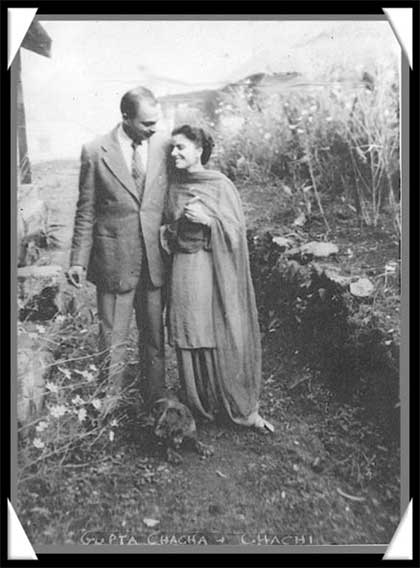 This exchange continues, off and on. When Abi dies, Ummi receives a very warm letter from them, asking "Bhabiji" to stay with them in Dilli for a while. But the trip never materializes. We couldn't afford it. Then, for some reason - possibly mail going astray after the 1965 war - we all lose touch.
For years I search for him ... but can recall neither his rank nor anything else. Whenever my ship is at an Indian port, I try to think up ways to find Gupta Cha. Trying to find a 'Gupta' in the Indian army, I am told, is just short of tracing the right 'Khan' in Afghanistan.
This exchange continues, off and on. When Abi dies, Ummi receives a very warm letter from them, asking "Bhabiji" to stay with them in Dilli for a while. But the trip never materializes. We couldn't afford it. Then, for some reason - possibly mail going astray after the 1965 war - we all lose touch.
For years I search for him ... but can recall neither his rank nor anything else. Whenever my ship is at an Indian port, I try to think up ways to find Gupta Cha. Trying to find a 'Gupta' in the Indian army, I am told, is just short of tracing the right 'Khan' in Afghanistan.Soon after 'Uncle Kaura' arrives, I decide to go wish him. I plan to remember to say Aadaab in the old tradition but my Pakistani Radio Officer - a Lahori - tells me that that was not as common a greeting in Punjab as in Delhi and the U.P., so maybe I should say Namsté to be polite. I walk in and say that, a bit awkwardly, failing badly at the hand coordination for the accompanying gesture. Uncle Kaura - originally from Rawalpindi - says. "Aray ... hum to soach rahay thay keh bohat din baad Salaam Alaeküm sünnay ko milay ga ..." and soon the talk turns to his homesickness and losing touch with old friends. He regrets forgetting to write Urdu well.During the stay I recount 'our' partition story and he asks me if there is anything I can recall about Gupta Cha that could help trace him. Apart from his first name, Birjesh, I usually can't recall anything. But from some hidden corner of my mind, that day, I bring forth two facts that I'd never consciously recalled earlier. Someone in Gupta Cha's family - possibly his father? - was a Judge. And they lived in a house called Bürj Mahal in Meerut. Before he leaves the ship and heads home, Uncle Kaura says he will ask some old colleagues about Gupta Cha but doubts if anything will come of it. Five days later, I am standing at the Shipping Agency office when I am handed an envelope posted from Delhi, addressed to me. I open it and discover a letter in Urdu in a shaky hand. It starts "Pyaaray Baytay ...". "How sweet of Uncle Kaura," I think to myself, "to try and write in Urdu after all these years." But the next para that I read (writing this I am still feeling the same sensation as I did then) is something I cannot believe. I jump ahead and look at the bottom of the next page. YESSSSS! It says "Tümhaara Gupta Cha". It takes me an interminable amount of time to absorb this. A clerk comes up and asks if I am OK. I have tears streaming down my cheeks and can barely speak as I read about Gupta Cha thinking each year of me on my birthday, admittedly not difficult to remember in India (It's Gandhi Ji's, too!). I read and re-read the letter. He wants me to fly out to Delhi. Of course I cannot (not just because of the visa but because we sail out in 2 days).
It turns out that Uncle Kaura, immediately on his return to Delhi, took a bus to Meerut and spent the day searching for Bürj Mahal. Unsuccesful at his attempt, he stopped at a shop in a multistory building to have a cold drink before taking the bus back. The shopkeeper and he got into a conversation and he mentioned his search for Bürj Mahal. "This very building is where it used to be," said the shopkeeper, "and the old owners live right on top, I think." So up climbed Uncle Kaura and met Gupta Cha's sister-in-law and told her the tale. She recalled our family and informed Uncle Kaura that Gupta Cha lived in Delhi! Defence Colony!! One lane behind Uncle Kaura's house!!! (Yes, Woody Allen. Life does imitate bad television!). So it is to Uncle Kaura that I owe more than I had realized.After I regain control of my senses (and I am not dramatizing this ... it did take a while, as 36 years and all that's happened in that period ran through my mind) I immediately decide to phone him. And Ummi. Getting connected to Karachi, oddly, happens very quickly but I just manage to tell her that I've found Gupta Cha when, even more quickly, the line drops and we cannot get through again. Getting through to Delhi is a 'trunk call' - as calls between cities were then known - and requires a 'booking'. "It's about a 3-4 hour wait," says the operator. The manager of the agency, who, like everyone else in that room, has heard bits of my story by then, takes the phone from me and says something in Marathi, and then translates it for me. "Maeñ saalay ko bola 'Yeh jaldi type ka call hae! Death and Illness Emergency'. Abhee das minat mayñ mil jaae ga." Of course I can't recall the conversation with Gupta Cha. Too full of both of us trying to fill the other in about everyone and everything. Sobs. Laughter. He tells me he has two children. The son, nicknamed 'T2' is in the army. His daughter, Nanu, is married to Sunil who is in the Navy and is posted in Bombay. I am excited. "Can I see her?" Gupta Cha gives me the address of her house in the Naval Colony and, still reeling from all this, I am put on a rickshaw by the friendly clerk who first tells the driver my story and then instructs him to wait wherever I am going and bring me back later and collect the money from the office as part of the celebrations for my joy. Awwwww.
Later, I have laughed often at the thought that the Indian Naval Security services are at the same level as ours - recalling that in the 60s, when we docked in Karachi with ammunition that our ship had brought in from Iran, the whole port area was under security and passes were required to board the craft. Not even our own officers could step onto the quay and board the ship again without passes. Sitting in my room, I nearly leapt out of my chair as I saw an old friend from India walk in. "How the eff did you get on board? It's bloody tight security!" ... Bhagwan Das winked and said, "Full Paanch rupyah diya gate vaalay ko, yaar!"
The meeting with Sunil and Nanu was great. It was like being at home with people I'd always known. No takallüf. They already knew of me. Their elder daughter, Ayeshah, (named by Gupta Cha) fell asleep soon but I did get to carry around the new addition, 4-month old Amrita, after eating a lovely home-cooked meal, so that Nanu could eat in peace. I wish the ship would have stayed longer so I'd have got to spend more time with them. For a year or so Nanu and I managed to stay in occasional contact, but Sunil was then posted to Vishikhapatnam, I think, and none my letters ever reached them, so we lost touch.

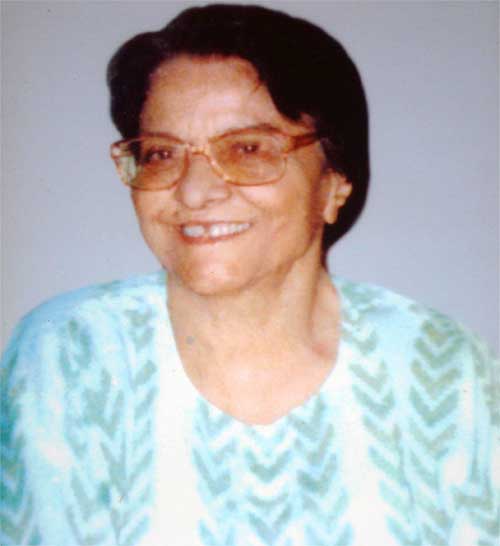 He told me they were letting go of the house and he was taking Chachi along to wherever he was posted then. Chachi came on the line - and in one of the most touching moments for me in this strange saga - asked me if it would be possible, before they left the house, to come and stay a day or two in the room that Gupta Cha had earmarked for me. I tried but I could not get the NOC needed for a visa. (Although I had left the sea - swallowing the anchor soon after my daughter's birth … and Ummi's accident that confined her to a wheelchair … and started a company of my own, my passport still showed Merchant Seaman as my profession, so our Ministry had to issue NOCs.)
I never managed to contact T2 and Nanu again. Uncle Kaura, too, passed away before I could find out the address from where, maybe, I could get a forwarding address they'd left behind.
He told me they were letting go of the house and he was taking Chachi along to wherever he was posted then. Chachi came on the line - and in one of the most touching moments for me in this strange saga - asked me if it would be possible, before they left the house, to come and stay a day or two in the room that Gupta Cha had earmarked for me. I tried but I could not get the NOC needed for a visa. (Although I had left the sea - swallowing the anchor soon after my daughter's birth … and Ummi's accident that confined her to a wheelchair … and started a company of my own, my passport still showed Merchant Seaman as my profession, so our Ministry had to issue NOCs.)
I never managed to contact T2 and Nanu again. Uncle Kaura, too, passed away before I could find out the address from where, maybe, I could get a forwarding address they'd left behind.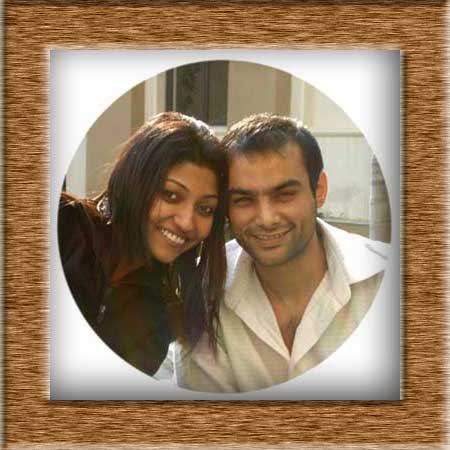 Just a few days earlier that city had suffered from bomb blasts (obviously, the blame was laid at our doorstep, as is customary) so getting a visa to that city was out of the question.
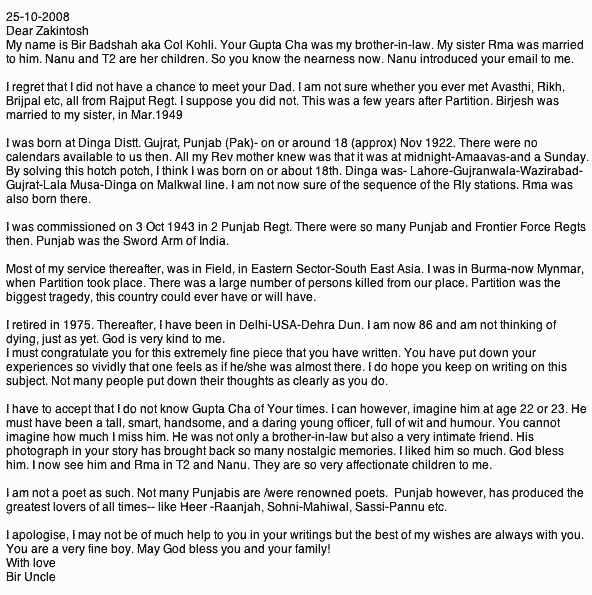
 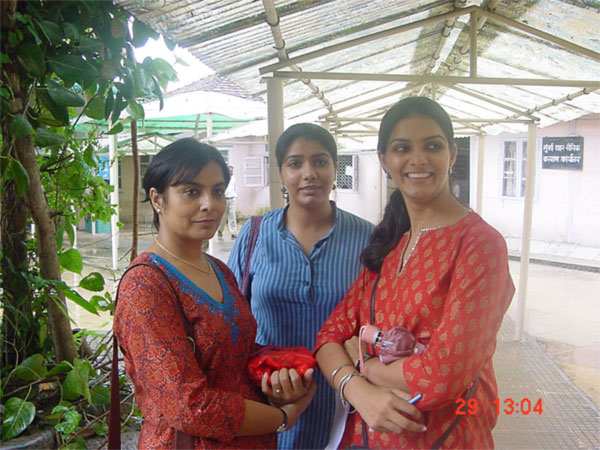 If ever there could be a suitable postscript to all this, it's this email I received just a while ago.
Peace!
If ever there could be a suitable postscript to all this, it's this email I received just a while ago.
Peace!Labels: Books, Events, Music, Pakistan, People, Personal, Poetry
posted by Zakintosh at 4/21/2023 06:23:00 PM
|
16 comments